Hagerman Fossil Beds National Monument
Visiting Hagerman Fossil Beds National Monument
During your visit to the Hagerman Fossil Beds National Monument orient yourself with the Hagerman Fossil Beds in the Visitor Center. Hagerman Fossil Beds allow you to explore plant and animal fossils prior to the Ice Age and the late Pliocene’s earliest appearances of modern flora and fauna.
Visitor Center
Start your visit to the Hagerman Fossil Beds National Monument in the Visitor Center. Located on Route 30 in Hagerman, the Visitor Center features a short film that will orient you with Hagerman Fossil Beds National Monument. Dig like a palaeontologist, examine fossil replicas and marvel at displays that showcase fossils found in the Hagerman Fossil Beds as you explore the Visitor Center’s exhibits. You can also obtain useful information from staff in the Visitor Center about the amenities available in the area.
Hagerman Fossil Beds
The Hagerman Fossil Beds National Monument is nationally and internationally recognized for its world-class paleontological resources. It boasts the world’s richest known fossil deposits from the late Pliocene epoch in quality, quantity and diversity. The collection includes over 200 species of plants and animals that represent the last glimpse of time that existed before the Ice Age and the Pliocene’s earliest appearances of “modern” flora and fauna.
The Hagerman Horse
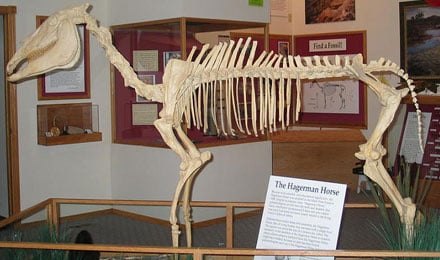
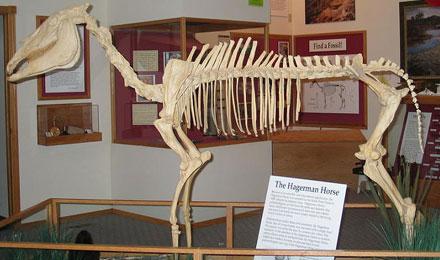
The Hagerman Fossil Beds hold one of the world’s richest known deposits of fossil horses, Equus simplicidens. Many experts have thought such fossil horses to be the link between prehistoric and modern horses. The Hagerman Horse became Idaho’s state fossil and Hagerman Fossil Beds became a national monument in 1988.
Other Animals
In addition to the Hagerman Horse, other fossil species have been found in the Hagerman Fossil Beds. Fossil species include the lake cat, sloth, sabre tooth cat, muskrat, peccary, snakes, ferinestrix, turtle, otter, shrew, grison, swan, bear, camel, giant marmot, catfish, hyena-like dog, cormorant and mole.
Plants
Sagebrush steppe plant communities, once common to the intermountain region of Southern Idaho, surround the Hagerman Fossil Beds National Monument. Shrub steppe communities are dominated by shrub, often sagebrush mingled with open, sparsely vegetated areas of grasses and forbs. The Monument’s steep slopes, west of the Snake River, contribute to the diversity of plant species. Additionally, a riparian zone and localized wetlands are visible along the reservoir. Among the known native plant species are Russian olive, Russian thistle, quackgrass, cheat grass, blue mustard, tansymustard, Tumble mustard and medusa head.
Travel Tips
- Hagerman Fossil Beds National Monument offers seasonal ranger programs that allow you to get up close to the fossils and learn about the amazing history behind the Hagerman Fossil Beds. Visit the official Hagerman Fossil Beds National Monument website to find out more about what Hagerman Fossil Beds National Monument will offer during your visit.
- The Hagerman Fossil Beds National Monument is ADA complaint.
- Be sure to stop by the Visitor Center’s Gift Shop carrying items unique to the Hagerman Fossil Beds National Monument and Hagerman, Idaho.
Hagerman Fossil Beds National Monument, Hagerman, ID
Explore the wonderful world of fossils at the Hagerman Fossil Beds National Monument as part of this group motorcoach vacation package. Located on the west bank of the Snake River, minutes from Hagerman, Idaho, the 4,351-acre Hagerman Fossil Beds National Monument is internationally renowned for having the world’s richest known fossil deposits. These fossils represent the last glimpse of the time that existed prior to the Ice Age and the late Pliocene’s earliest appearances of modern flora and fauna. Since the Hagerman Fossil Beds were designated as a National Natural Landmark in 1975, over 3,000 new fossil fragments have been found each year. The Monument welcomes visitors from near and far who come to discover different species of fossil plants and animals.